Home

Wednesday, 13 March 2019

12.03.2019
For the run up to our end of year show, we set up a test exhibition to try out different set ups or finished works. As my solo exhibition at AirSpace was fast approaching I wanted to set up the main sculptures and elements to receive some feedback.
Using a plinth to display 3 sculptures I tried to translate a shopping environment. With the display of mannequins in front, and the clothes racks for rummaging behind. As this was just a test exhibition and I only displayed a selection of the main pieces, I kept it quite bare with a traditional white cube style display. Seeing these works in that way proved that they needed to be contained and within a scene behind them, the bare and clinical feel felt very cold with a more confrontational message. Although this could've been the way I chose to display at AirSpace, I wanted to create an atmosphere that was less loaded with accusations. Making the display in a way that didn't point the finger was very important to me as my aim is to inspire change, not make anyone defensive or dismissive.
As I was talking through my ideas and intentions for AirSpace there was some confusion over why am I making a shop and what am I selling? Making it into a shop environment is to highlight where the neglect to the marine life and surrounding species is taking place, in food and product packaging. We are the consumers purchasing products wrapped in a dangerous and harmful material, and will be looking into the shop at the impact these plastic materials are having. We had discussed using a vinyl sticker with a fact or quote in the window to add some context for the viewer to help them understand my message. I think I have decided against this as hopefully with all the elements together they will be able to read the story themselves. It's important that this work makes a strong impact on the audience and part of that experience is doing the type of 'research' into the exhibition, similar to how we should be researching into our situation. One way I can make sure there is some clarity if someone can't work it out themselves, is by perfecting an artist statement. This needs to include why it is a shop, why I have used certain materials, what type of pollution its targeting, and what is my aim of the display. 
Other than concerns about about the audience receiving my work, I had some reassuring feedback that the sculptures ignited a deep discomfort and sadness. They are powerful pieces of imagery loaded with different emotions, I believe they will really stick in peoples minds and make them reconsider the amount of plastic within their household. 


Sunday, 10 March 2019

07.03.2019
Thursday we had a visit from artist Jasleen Kaur who's work focus's on identity politics and structural inequalities. Jasleen's practice is informed from inherited issues, a result of race or culture, whilst exploring personal histories of herself or others around her. 
Asking what is culture, and who benefits from cultural production? 
Jasleen explained that the word culture originates from agriculture, a word of hard work and labour. Culture is the everyday woman in her kitchen making a meal for her family that's been passed down from tradition, not necessarily an exhibit in the V&A that's labelled so. Culture is something people work at and try to keep alive. 
Jasleen went on to discuss a project she completed in 2010 where she wanted to transform the statue of Robert Napier, who fought in the first and second Anglo-Sikh war, by putting a turban over his helmet. As she was having trouble with getting permissions from the council and needed permission from the family, the direction of her work was took off course. She contacted the grandson of Robert Napier and instead of putting the turban on the statue, she asked if she could put one on himself. By wanting to tackle the power wealth empire of the men in statues in our cities, this had taken her to a direct descendent of someone who was of different ethnicities and cultures, but together, shared a piece of history. This turned into a more socially engaged practice and I would say a more successful one. They were able to share this intimate experience of her dad building the turban whilst they discussed their connections and the consequences of the war. 


I found this whole process fascinating and reassuring that even when something isn't going quite to plan, there's always an opportunity to create something remarkable. 

06.03.2019
For my four main sculptures within the installation I have been making them with a plastic base polymer clay. As you have to bake the clay for hardening once you've finished the making process, the base needs to be oven-proof. For my base I have used aluminium foil tightly packed and moulded into the shape of the animal I was making. I would then apply the layer of clay similar to a layer of skin. Polymer clay is typically used for smaller scale sculptures or objects as its quite an expensive material. But as using a plastic base clay was important within the context and story of my work, a smooth base was imperative to reduce the amount of clay being used for filling lumps and bumps. Creating a dense base is also key to the sculpture keeping its form. 


Using an array of images of Sea Turtles I then added the layer of clay very carefully creating lots of detail within it's skin and shell. After baking I used an acrylic white paint to create a mannequin feel to add to the shop details, as I would with all sculptures. I also will add a shiny glaze to their eyes to create a teary sadness within them. 


Making the Seal, Penguin and Turtle sculptures were quite straight forward as they would be free standing on a surface. The Seagull/Stork sculpture was slightly more complicated. Originally the photo the sculpture was based on was of a Stork, but reading into the measurements and scale of the bird, it was too large to recreate. So I then adapted the sculpture to become a Seagull. The next issue I had was calculating a way of making the sculpture so that it had the least amount of separate pieces as possible. My oven is quite wide so I was very lucky that I didn't have to make the wings separate and attach them afterwards or even on site. This would've had its risks as if they were too heavy they could've snapped off and I would've had to work out a type of attachment that could be embedded in the wings before baking. I decided to make the legs separate as when it would've been in the oven baking they would be at too much of an awkward angle and likely be damaged. 
Also as the bird was to be hung from the ceiling with fishing line, I had to make the bird with an attachment to allow me to hang it. This attachment had to be strong and have the weight of the sculpture evenly distributed so that it wasn't too heavy and would break off. I thought about how I can create a strong enough loop within the base and decided to use a thin but strong metal wire to wrap around the aluminium base of the bird, and twisted into a circle above the surface of where the clay would be. This has allowed me to have a subtle but sturdy way of suspending the bird.


I had made the base out of aluminium foil but as the wings were so thin they weren't sticking out in flight mode but instead flapping down. This stopped my making process until I could work out a way to keep them upright. Thinking about materials I could use I purchased some bamboo skewers. Taking 4 skewers at 30cm in length I pushed them through the aluminium foil and around an inch or two into the birds body so it would hold. Mirroring this on the other wing they stood in perfect position. 
Using the same idea of wooden skewers but in cocktail stick form, I created a thin base of aluminium foil covered in clay with an inch of the sticks uncovered to create the bird's legs. By baking these first and separate, this allowed me to work out where they would be attached and remove a small circle of clay. This is so that when I attach them they will go straight into the aluminium base, slotting inside the body, making no clue that they were made separately. When I attach the legs I will put a small blob of hot glue to keep them secure. 


Once the sculpture was ready to bake the wings had dropped ever so slightly, this meant I had to bend them to get them into the oven. This was seemingly no issue until I removed the sculpture and it began cooling. From where in the cooling period the angle of the wings changed from when it was baking I started to get some severe cracks in the clay. Luckily they were only on one side of the wings so didn't damage the structure of the sculpture. I then filled these cracks with some glue which seemed to hold it together. 


Other than a couple issues with the Seagull sculpture I'm happy with how the sculptures have turned out and have enjoyed the making process of trial and error. 


24.02.2019
With my AirSpace exhibition fast approaching it has been quite difficult keeping on top of every element needed in my installation. By creating a scene instead of merely displaying a couple of finished artworks I have had to add lots of details and elements correlating with the shop-front format. 
One of these elements has been creating a light/lampshade. Using a water dispenser bottle cut in half I created the base to the lampshade. Then taking a hot glue gun with different length plastic straws I was able to create a very textured and interesting lampshade, similar to those I saw in retail shops such as Ikea. 
Interestingly it turned out looking like some underwater creature in the realm of an urchin. I'm pleased with how it has turned out as I was concerned it would look crafty but instead could pass off as something you could actually purchase. This lampshade will be suspended from the ceiling of my exhibition window illuminated by an ECO bulb. 


Wednesday, 6 March 2019

04.03.2019
Monday this week I had a meeting with the students union and their marketing staff member to discuss press releases and posters for the plastic bottle top installation. This meeting consisted of going over dates and details for the workshops and brainstorming other ways we can get the students involved in the process. Some ideas were having a free entry night to the students union LRV Flashback Fridays when you bring a certain amount of bottle tops with you, drop off bins/boxes in the union shops and communal areas like the library, and potentially having a stall outside Ember Lounge for one afternoon.
We also selected two different dates the workshops could be held on. For the workshop with the University's Nursery I presented my idea of making a bottle top fish instead of a wave mirroring the end result. I thought this would be a better idea as we could use all the colours collected I won't be using for the final outcome (such as oranges and reds) within the scales/fish. This will leave a fun and colourful artwork for their wall, which I feel is more suited to young children. This also would help with content for the workshop as we can focus on facts surrounding the animals effected, which is also more suited to the age group.
I also was asked for the title and to write three lines with information on the artwork itself for the posters. I thought hard about what I should include within this text as it needs to summarise what were doing but also why. Here is what I came up with:
Plastic, The Slow Tsunami
Plastic pollution is damaging the world around us, becoming an un-natural disaster. We invite you to be apart of our campaign as we work to produce a wall based installation of Hokusai's The Great Wave from plastic bottle tops. It's vital we come together to create change.
It was a very exciting meeting hearing all the support and activities that are going ahead for this project, it's all starting to come together nicely and I'm very pleased to be apart of it.

Friday, 1 March 2019

01.03.2019
As well as the brochure I thought about producing a leaflet to gain a buzz and an audience to the window, a 'SALE NOW ON' leaflet coinciding with the shop scene. I had first created one that read 'SALE NOW ON' and 'Caught up buying the same products?' which was a play on words of how we buy the same products over and over not considering the journey before or after of the product. We are creatures of habit and could potentially not realise the damage we are doing. The Seal is also therefore caught up in the same products in a more literal sense.
After speaking to one of my lecturers we discussed how this could be read in too much of a jokey, playful way and could give people the wrong impression of what i'm creating or trying to say. Also as my intention is to hand these out to passers by in the local town I need to consider, is this ethically portraying the animals and could the images be disturbing to young children or certain groups of people.

After considering all the possibilities to misread the message or cause upset I decided to change it entirely. By reducing the information on the leaflet it reduces the risk of misinterpretation and also adds to the mystery and necessity of going to the window to see the work themselves. Using a photo of one of my sculptures instead of the animals eliminates the question of am I handling the images of animals with enough care, but also gives a taster of the work in the window as well. 

01.03.2019
Along with making sculptures and creating the installation I want to have some documentation accessible for passers by who are further interested. By linking it with the whole shop arrangement, I used the idea of creating a catalogue/brochure to hold the items on 'sale' (which were the items exhibited). I have made the brochure to hold the images the separate pieces were based on, the photos I had found of the pollution debris devastating our natural wildlife. Featuring the photos the work was based on instead of the sculptures themselves shows that they weren't imagined circumstances and aims to shock the reader. Pairing each photo and item on 'sale' with a fact on pollution is making a statement that this is all burdening the animals for free. The price the animals pay are not of a monetary sense, but of pain and suffering.
Out of respect for the information I am relaying I wanted to make the brochure quite serious and informative as we should be taking the facts very seriously. Impactful and easy to read I am quite pleased with how professional and clear they have turned out.
I also added information of how the reader can get further involved in taking a stand themselves, and added my blog so they can read more about my process and thoughts behind the work.


Friday, 22 February 2019

22.02.2019
Having heard back from Glen at AirSpace Gallery, my proposal has been accepted so I need to start finishing works off and getting fully prepped for the week. My 'In The Window' exhibition will run from installing on Sunday 24th March through to de-installing on the following Friday 29th March. My Proposal for the space is as follows:

PolluShine– Is It Worth It?
100% from the ocean 

My practice – 
I am currently a Level 5 Fine Art BA (Hons) student at Staffordshire University. Recently I have opened up my practice by experimenting with sculpture and have attained a love and appreciation for the three-dimensional world of art. Having gained some experience in prop making and scenic art within theatre, I was able to experience installation in a different context compared to a gallery setting. This has inspired me to create my own displays and scenes. Being a vegetarian and a conscious recycler I spend a lot of my time worrying about the waste in products I use, instead of being proactive and being part of the change. Producing work that could make a difference has always been an aim of mine, to leave a mark on someone and alter their perception, even if in the slightest way. I haven’t had an opportunity yet to reach a wider audience, and AirSpace would give me that chance. The more we see about how our lifestyles are damaging the world around us, the more likely we are to adjust. 
Aims –
I will create a luxurious staged shop window of a jewellery/clothing store ‘PolluShine – Is it worth it?’ to highlight how barbaric and damaging we are being to marine life and surrounding species. By featuring the animals we are neglecting through pollution debris we are leaving behind, I want to create a confrontational display in hopes of provoking change. By using recycled items and a plastic base clay I want to keep the materials a true reflection of the context. Including play on words like Pollution and PolluShine, Garnier’s ‘because you’re worth it’ slogan and other hidden gems. 
Proposal – 
I propose to have in one half of the window a large table covered entirely with a silver fabric and a three-part mirror, along with polymer clay sculptures of the animals/heads made in the fashion of mannequins. These animals will be promoting our pollution as fashion accessories or jewellery. The table will be eyelevel to those walking past so they can see the animals and themselves in the reflection. The jewellery and accessories featured will be a Penguin cape (beer plastic around neck), a Turtle nose stud (straw in nostril), a white stork rain coat (clear plastic bag) along with a few others. In the adjacent window, I will continue the theme and have a silver clothes rail featuring a few ‘one size fits all’ clothing items (also relating to images sourced) e.g. a fishnet dress suitable for any specie. From the ceiling I will hang the stork along with sun catchers fashioned from melted plastic beads and have a plinth displaying the seal head. 
My hopes for this project is to make a believable shop window that’s glamourous and enticing as viewers walk by, but they soon realise it’s a shop of horrors. I would love to be able touse AirSpace as a platform to reach more people than I ever have before, including a wider collection of people.  As the window is located in a busy pedestrian area in town, it opens up the possibility to an audience who may not normally access galleries or enter the world of art. 
Logistics – 
For technical requirement’s I would need access to a plug where I can use an upcycled plastic straw and water barrel lighting lit by an eco-bulb, and hang some elements from the ceiling with transparent fishing line. I would also use a tulle fabric hung by a thin curtain wire against the back wall. Along with the display in the window I will be handing out leaflets promoting a ‘sale’ to create awareness, also having brochure of the items. Using images the pieces were based on, instead of the price in a money sense it will be the price the animals pay each day. If possible I would like a leaflet holder outside holding this brochure. 


21.02.2019
Antonio Roberts was next on our visiting artist programme and he is actually a past student/graduate from our university. Now being a digital artist, art made with error and coding, a very unique form of artwork. Coding to me feels very matter of fact and restricting. Each formula or sequence will work in a specific way and nothing else, emotionless and predictable. But Antonio proved that it doesn't have to be predictable at all. As he showed us a few one minute clips of the videos he has produced (a mere snippet of the full length videos), they were anything but.
Antonio explained a fascination with copyright and how it's almost been lost in this digital age. Reposting photos or videos on facebook, sending them in text messages or adding captions to create 'MEMEs' are just some ways you could be in violation of the copyright laws. For example if Youtube channels/videos use another video clip, they tend to add "no copyright infringement intended" thinking it allows them use of the video/clip, when actually you're still acting against the law. Copyright laws are dated and in some ways no longer relevant because of these reasons, so does copyright still exist? The answer seems to be only when someone with enough money and/or lawyers chooses to enforce their rights to said image/video etc. Antonio agrees that there needs to be an appropriation of using other peoples work (or image) but should not be ruled out completely. Adaptations and versions of past work happens constantly. It would be very rare if not impossible to come up with an idea completely new which hasn't already been done in some way. We should instead be using and encouraging each other in our creativity inquest. Antonio explained he believes real creativity is taking something that's been done and making it your own. He encouraged us to ask ourself in the future, why am I using this image and is it appropriate/ethical to be used? But also question who is allowed to appropriate culture? Who decides one thing is okay compared to another?
It was really inspiring to see a past student of my university established in his practice, and has opened my eyes to the world of glitch art.

https://www.hellocatfood.com
14.02.2019
Rosalie Schweiker came to our university for the visiting artist programme this semester and gave a really interesting twist on a lecture. She explained she used to have a copy of  'The Little Red School Book' and how it used to educate teenagers on topics you might not have found in school, such as sex and drugs. In the 1970's you didn't have the internet, a go to place for answers to questions that might've been too uncomfortable to ask aloud. So some people were getting themselves into situations they weren't prepared for, or could in some cases, become dangerous. The book at the time was seen as outrageous, but as Rosalie explained, was a safety net for many of its readers. This idea of having a backup plan and a point of call for information right inside your pocket was a comforting precaution. Which lead Rosalie to develop this idea into something we could use in the present. As sex and drugs aren't that much of a hot topic anymore and we're able to find answers to our questions on search engines such as google, the path of her book lead down another direction. Rosalie explained that she rarely sells her work but still earns as a working artist. She spends a lot of her time presenting lectures or talks, or with workshops and lessons in schools. Which the idea then became a book by Rosalie and Mirjam Bayerdorfer 'Teaching   for people who prefer not to teach'.
A magic 8 ball of learning, each page reveals a different answer, an activity or discussion to be had. This can be chosen by the teacher or as Rosalie said is intended, by the class themselves. This is a fun and exciting way to teach and learn as the power of the classroom is disrupted and handed back to the students.
As the books were handed out for us to have a read it was clear this was the direction of the lecture today also. Our lecture was to be exploring Rosalie's calendar for this month (as she picked from the book) and we spent the hour finding out what it's really like to be a working artist. As she spoke about her month of current projects to yoga class I found it a very useful incite into how you need to stay organised and network yourself all the time. There are opportunities everywhere and creating this publication was just one that allows Rosalie's work to travel, and reach a wider audience.

http://rosalieschweiker.info/come-along/

21.02.2019
As Easter is fast approaching and the piece for the university needs to be complete by then, myself and the students union need to get press releases and posters around campus as soon as possible. Spreading information about workshops and drop off points for bottle tops is essential as I will be relying totally on students and staff coming together for materials for the work. Coming up with a photo for these posters was at first a difficult task, as the work wouldn't be complete or even started until after said workshops and campaigns, getting a photo that relates and connects with the end result took a while. After going through ideas about drawings or having a collection of bottle tops laid out in a certain way and photographed, I wanted to create an image that was more of a completed outcome itself. I brainstormed a few ideas sticking with the theme of a wave and thought about creating a wave that looked to be from the ocean but instead was formed entirely of plastic waste. This later developed into using Hokusai's original print but replacing the white with plastic waste instead. I found an image with 4 water bottles on it in different usage conditions from filled and new to screwed up and crushed. In Photoshop I then manipulated them to look as though they were naturally apart of the original piece and the wave.
Using water bottles within the image instead of bottle tops (which will be the material used in the artwork), will remind everyone that there is even more plastic being thrown away than they can see when the work is complete, and that one water bottle consists of two separate pieces of plastic.
I am happy with how the image has turned out as the movement is still captured of the wave and on a quick glance you wouldn't notice the bottles within the print. I am excited to share this with the University at our next meeting.


Wednesday, 20 February 2019

20.02.2019
During 'Green Week' at my university there were discussions about having a piece of work produced for the courtyard reflecting the urgency of taking action against plastic pollution. After putting myself forward to be apart of the work, I have now become the artist behind the design.
This morning I had a meeting with some of the University's student's union staff relaying my proposed idea and to discuss logistics and dates, negotiating what we want to come from this work as a whole.
My proposal is to do our own interpretation of Hokusai's 'The great wave off Kanagawa'. Hokusai's print is quite a well known and recognisable artwork reflecting the natural disaster of tsunami's. We are at a point of crisis where an estimated 18 billion lbs of plastic enters the ocean every year, we are drowning in plastic similar to the effects of a tsunami itself. The ocean is vital to the survival of hundreds of thousands of species, including us.
We had agreed on the work being 2metres x 2metres to be placed on the wall next to the Cadman Gallery, front facing the entrance to the courtyard. Using a weather proofed hard board hoarding to be installed, I will use plastic bottle tops/caps with resin to seal the work reducing the risk of weathering. I will use bottle tops flat for the background and use them on their side for within the wave. This will create a sense of calculated chaos, up close you will see the movement and drama reflecting the life of a wave itself, and from a distance it will paint a picture of the ocean.
As well as producing a finished outcome to be mounted on the wall, a vital part of this work is bringing the community together to make a difference. Creating awareness about action that needs to be taken and how the students and staff can help. We will be organising workshops with the University's nursery, students and staff where they will be given a chance to get involved by bringing in the material for the work (bottle tops), but also to learn about what they can do to help whilst producing some work together as a group, using similar or the same materials. This installation is about encouraging everyone to get involved together and make a real difference. We are the future and we need to work together to create change.


Wednesday, 30 January 2019

29.01.2019
I had a short trip to Prague, Czech Republic, this week and whilst I was there I noticed that in contrast to all their traditional Gothic and Renaissance style buildings, it was quite an urban and contemporary city. A few shop window displays seemed to blur the line between an art installation and  a decorated window. Using technology and screens as an aid to catch passer by's attention, one shop really struck me as innovative and creative with the props and items used to accessorise their shop display.
In one of the city centre's streets I also came across an art installation of a fishing net holding an assortment of plastic bottles and litter, lit with some colour correlating lights. As the piece was high up it was easily missable, which I think coincides with the possible message. As a culture we seem to know about the damage plastics are causing our environment and wildlife (especially in the more recent years) but seem to do nothing about it. Research and activists are providing us access to crucial information that we should be pursuing, but as this causes extra effort in our daily routines, we choose wilful ignorance over action. By having this statement piece there but easily missable or easily ignored it provides us a window to see how we know about the problem but choose to ignore it. Seeing activist art pieces tackling the same themes in a different country reinforces that this is a worldwide problem that needs action, but also excites me and gives me faith that little by little we can make a difference and encourage change.
During my stay we also visited the Prague Castle where they had staged scenes of what life for the workers in the Castle would have been like in the early 1900's. This was also helpful for me to see how they filled the space with different objects and props to make the area look lived in and natural. This is the effect I want to create and it was helpful to see different types of spaces who have similar intentions, and get a grasp of techniques I can implement myself.

Thursday, 17 January 2019

15.01.2019
After having a meeting with AirSpace's curator Glen on the 10th, I was able to really home in on what I wanted to say in my exhibit and get an idea of past window exhibitions to see how mine would compare.
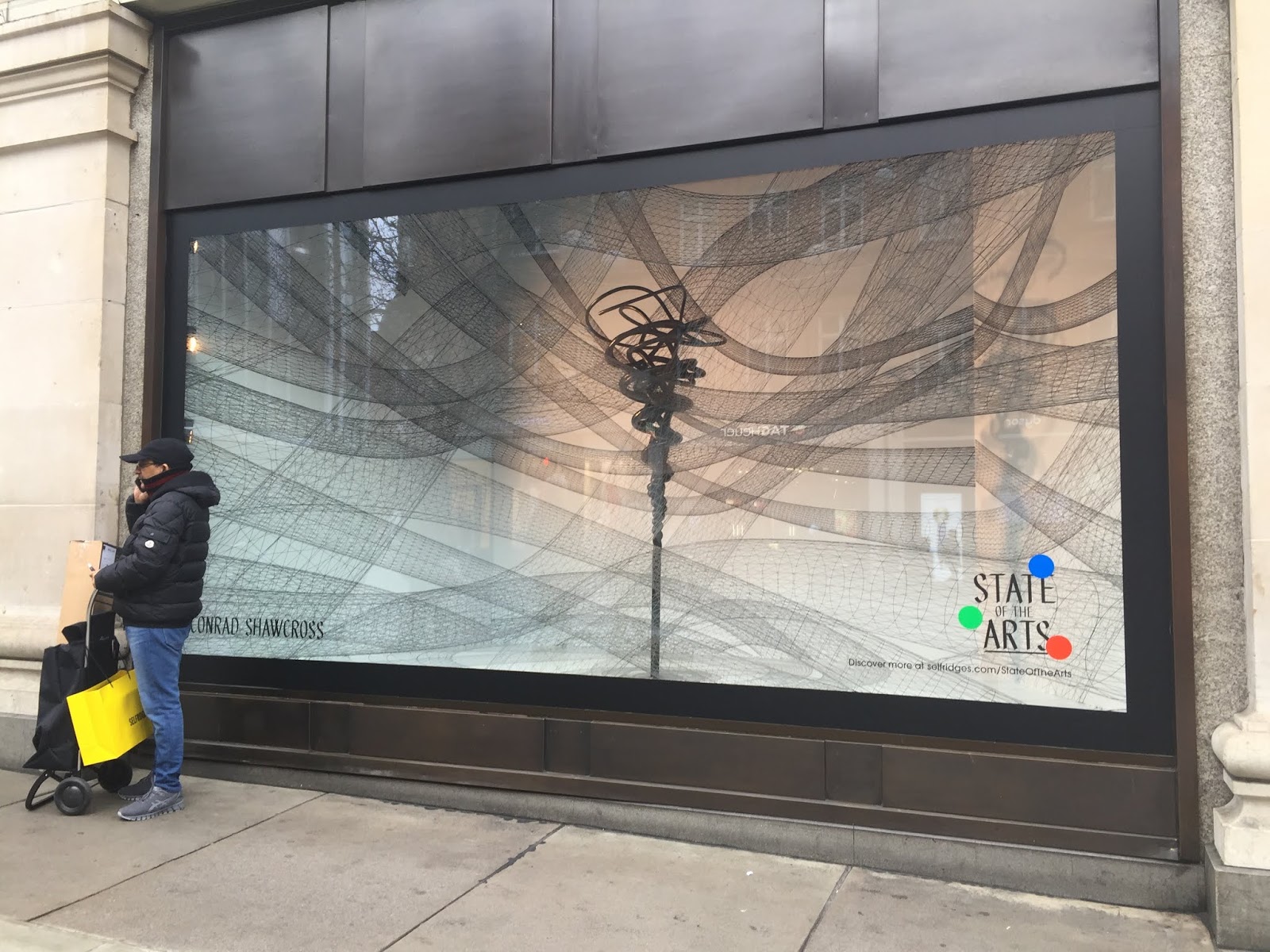
I had seen on the Selfridges website that they were engaging in a creative campaign, State of The Arts, bringing art to unexpected places. From my last visit to Selfridges I was able to delve into their window displays for Christmas and I was excited to now see window displays that directly link to my vision.
Featuring art in their Oxford Street windows is a fantastic way to bring public art to a community, but also brings an exciting new way to experience art. This helps making it more accessible and broadens the audience you will reach, including some who may not normally visit galleries or experience art in a more traditional way. It also changes the way the art is viewed and the relationship with the viewer. Simon Periton explains that "The work will be experienced in glimpses and that's where a public artwork is different to putting a piece in a gallery". When visiting a gallery you expect to spend at least a few hours (potentially a whole day), spending time examining the art and reading the different emotions it gives you, where if you're riding the bus or walking past you really do have seconds. This creates a certain pressure and responsibility for the artist to grab the viewers attention as quick as they can and hold it for as long as they can. This grab and go, fast food style of exhibiting is new and exiting but also challenging.
Collaborating with some of the UK's leading galleries and critically acclaimed artists they have also created a 'corner shop' inside where you can buy a sculpture or painting as if it is a bag of crisps and a can of lemonade. I was shocked to see some of Jeff Koons' small balloon animals on sale amongst sketchbooks and pencils as if it belonged there.
Cass Art have also teamed up in the 'corner shop' where they are selling artist tools and mediums that customers can take home and try themselves, also putting on daily workshops or talks at 14:00 where anyone can join and get creative or involved with important conversations about the world of art. Again, this is opening up the (what sometimes feels closed) community of artists and art lovers showing that all is welcome, from established artists to someone walking by who just wanted to join in.
Although the work in the window was in a very different space to a gallery setting, they still had the same white cube feel with crisp white walls, feeling very clinical. It was great for me to see a similar use of a shop style scene but to also get some ideas on how I would do it differently.

http://selfridges.com/GB/en/features/articles/selfridges-guideto/state-of-the-arts


Tuesday, 18 December 2018

18.12.2018
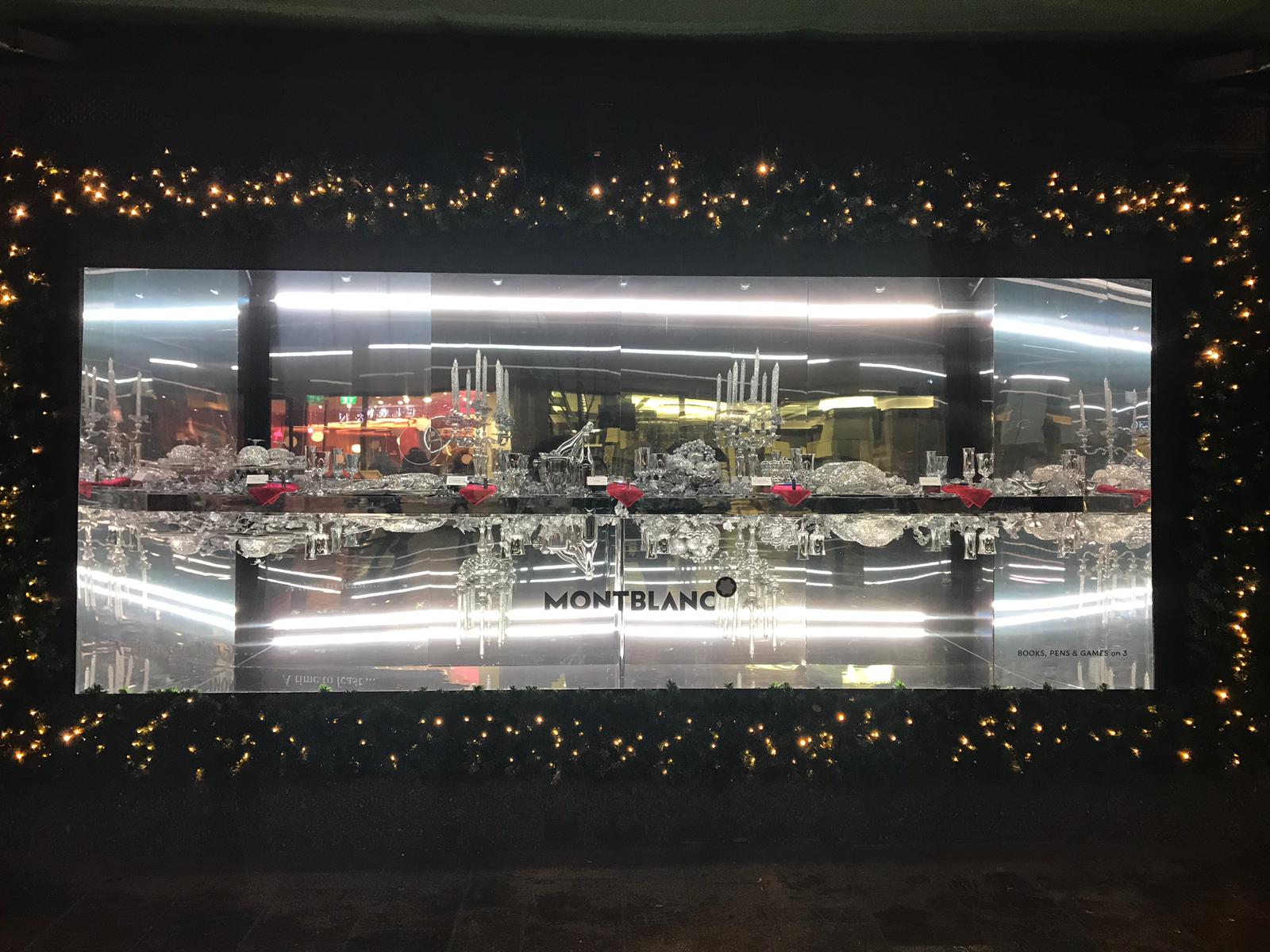
From spending a day helping Claybody theatre I wanted to see if I could arrange with the support and help from Airspace Gallery, a way to stage my own scene and set using their window exhibition programme. After speaking with the director Glen and preparing a proposal for how I would use the time and space, we have set to meet in the new year to discuss further my ideas and hopes for the project. My proposal featured an idea to create a shopfront called 'PolluShine - is it worth it?' focusing on the detrimental effects of pollution within our oceans. For inspiration and ideas on construction and application, I took a trip into London to see how high end shops such as Harrods, Selfridges, John Lewis and House Of Fraser treat their shop fronts and stores within the busiest and most competitive time of the year, Christmas. I was completely awe-struck with how elaborate and exciting these windows were. I felt transformed to another world studying every detail and consideration, almost forgetting that I was standing outside in the rain. Creating a fantasy that's equally believable than it is imagined is creating a new possibility for the audience. A magical modification of the world we know and live in. This has propelled me with fresh ideas and thoughts on use of lighting, movement and curatorial considerations to take in order to fill the space and command attention.


06.10.19 As I received an email from Curatorspace.com that my proposal had been accepted on the morning of Thursday 26th Sept, it only ga...